Donors: SIDA and UNESCO
Location: Phnom Penh, Kampong Speu, Kampong Chhnang, Kampong Thom, Pursat, Banteay
Duration: 2015-2018
Budget: 113,960 EUR
Introduction
Access to information is a fundamental right and a cornerstone of democratic governance. In Cambodia, the absence of a comprehensive legal framework for public information disclosure has long hindered transparency, accountability, and citizen participation. Recognizing this gap, API, in partnership with UNESCO and OHCHR, launched a multi-year initiative to support the development of an effective Access to Information (A2I) Law.
The project aimed to bridge the divide between government institutions and citizens by promoting participatory law-making and ensuring that the draft law reflects both international standards and the realities of Cambodian society. Through inclusive consultations, legal reviews, and capacity-building efforts, the initiative empowered civil society organizations (CSOs), local authorities, and communities to contribute meaningfully to the law’s development. The process also served as a model for collaborative policymaking, demonstrating the value of multi-stakeholder engagement in shaping legislation that serves the public interest.
Results
- Drafting and Legal Review
-
- The A2I Technical Working Group (A2ITWG), with inputs from UNESCO, OHCHR, and CSOs, completed the draft A2I law and disseminated it publicly on 31 January 2018.
-
- A legal team conducted nine sectoral legal reviews and consolidated them into one comprehensive report, distributed to government ministries, NGOs, the private sector, and the public.
-
- Two specialized reports on “Secrecy of Information” and “Complaint Mechanism” were developed and submitted to the Ministry of Information, UNESCO, and OHCHR.
- Stakeholder Engagement and Advocacy
-
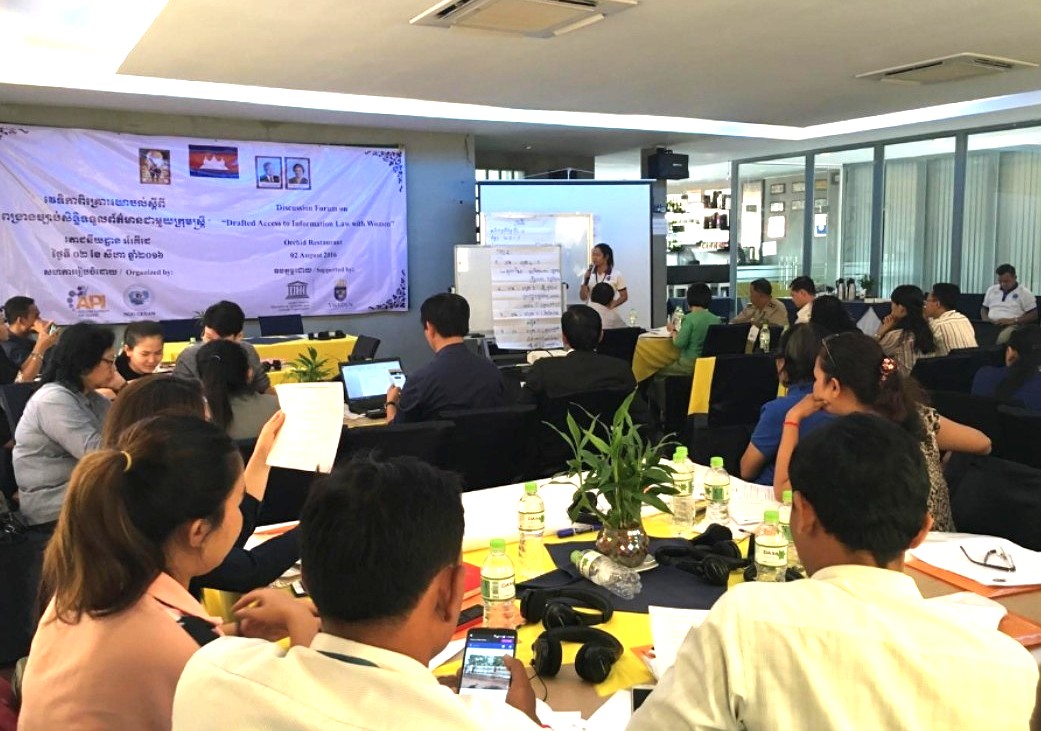
- API organized seven sectoral consultative forums and multiple expert meetings with CSOs, UN agencies, and government institutions to gather inputs and advocate for integration into the draft law.
-
- Inputs focused on general provisions, rights and obligations, procedures, confidentiality, protection for whistleblowers, and enforcement mechanisms.
-
- API and CSO representatives held advocacy meetings with ministries and parliamentarians, resulting in the inclusion of several CSO recommendations in the draft law.
- Capacity Building
-
- A training curriculum on A2I was developed and used to train 166 local councilors (50 women) across six provinces.
-
- A reflection and learning workshop was held in Siem Reap with 34 local authority staff to assess training outcomes and gather feedback.
- Public Awareness and Outreach
API and partners conducted 150 radio talk shows, community forums, and outreach campaigns, engaging over 10,000 community members (4,137 women) to raise awareness on A2I.
- Sustainability and Impact
-
- The project fostered strong collaboration between CSOs and government institutions, built legal and policy knowledge, and strengthened political will for the A2I law.
-
- The draft law incorporated international standards and principles, and the participatory process served as a model for future law development.