Training Courses

Explore our course witj expert team

20 results

Sort by date

Advocacy

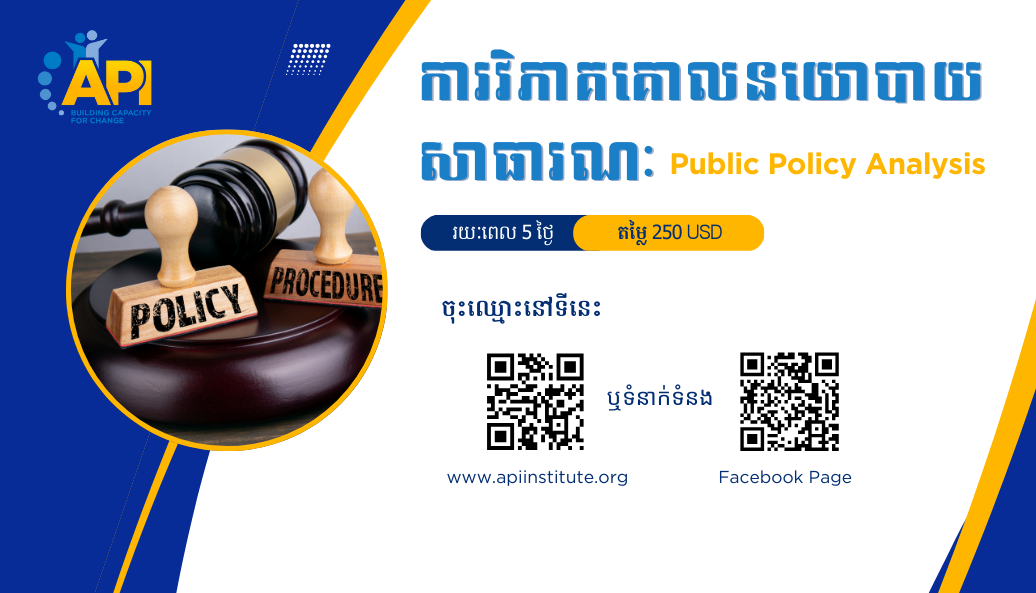
Public Policy Analysis

The main goal of this course is to build capacity for advocates to better engage in the strategic policy dialogues, especially in the formulation and the implementation of policies and strategies. The training sessions are designed and conducted to answer questions like: Why do policies, policy implementation practices and gaps in policies matter at all? What are the priorities, problems and solutions related to a certain, concrete policy? Who are the key stakeholders involved in or affected by that policy? How to design an advocacy action plan for addressing the identified issues? What are the main concepts, frameworks, techniques, principles, and best practices used in advocacy? How to debate on critical issues, develop advocacy messages, and prepare advocacy briefing papers for policy makers, the media and the general public? How to develop tools for monitoring the results of the advocacy campaigns, especially the results of meetings with government officials? Which individual and interpersonal skills, which networks, which teambuilding measures are relevant for advocacy, and how to develop good leadership?
on-demand
5 days
250 USD
Advocacy

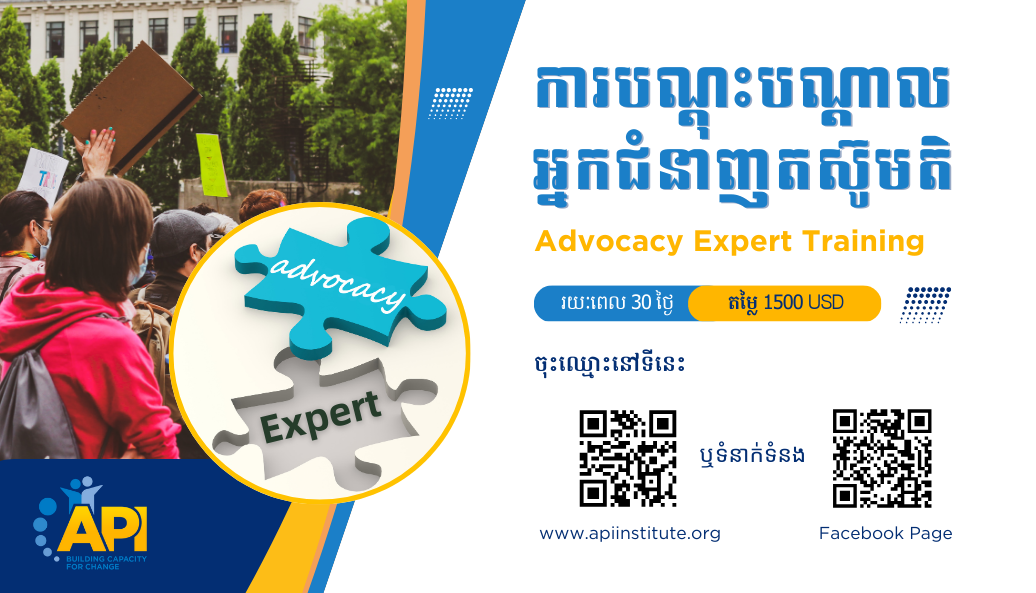
Advocacy Expert Training

Public officials currently still have a limited understanding of the right to access public information. Misconceptions about this topic are still widespread, generally being only based on superficial coverage during television and radio programmes or on social media. This training aims to build the capacity of sub-national government officials and local councillors on the key contents of the draft for an A2I law and other relevant legislation, as well as on the guidelines to be implemented in the field of information management and disclosure to support the open government initiative. During the course, our trainers will explain the positive impact of information release, and participants will share their experience and their current practices of information disclosure. As a result, they will become familiar with their roles and duties in disclosing information, the procedures of requesting and supplying information, the concept of confidential information, the complaint mechanisms available, and the sanctions the new draft law stipulates for non-compliance and failure to disclose public information. The course also aims at teaching public officials how to manage information in insightful ways, using modern technology.
on-demand
30 days
1500 USD
Access to Information (A2I)

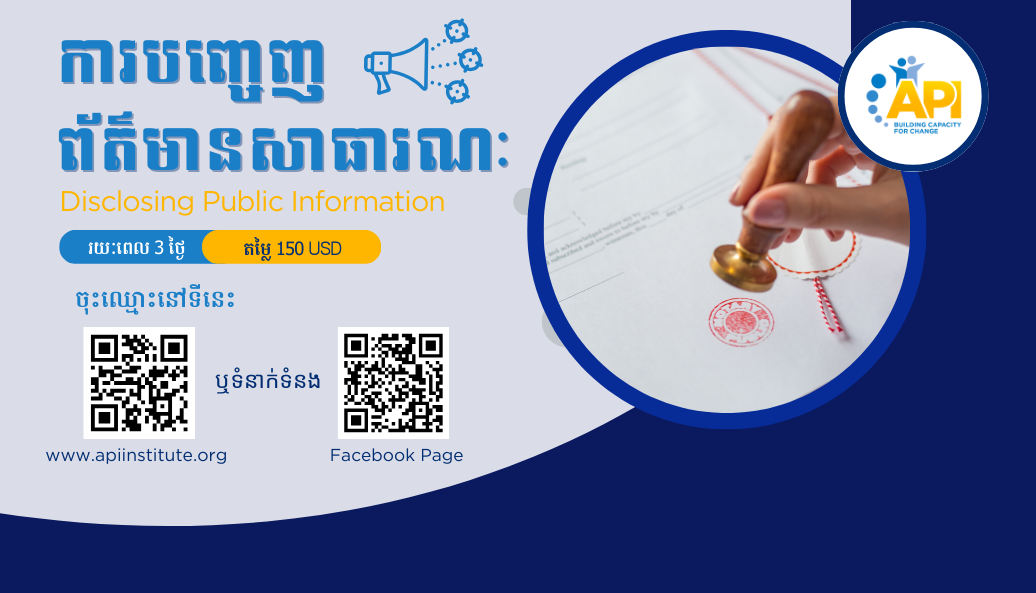
A2I – Disclosing Public Information

Public officials currently still have a limited understanding of the right to access public information. Misconceptions about this topic are still widespread, generally being only based on superficial coverage during television and radio programmes or on social media. This training aims to build the capacity of sub-national government officials and local councillors on the key contents of the draft for an A2I law and other relevant legislation, as well as on the guidelines to be implemented in the field of information management and disclosure to support the open government initiative. During the course, our trainers will explain the positive impact of information release, and participants will share their experience and their current practices of information disclosure. As a result, they will become familiar with their roles and duties in disclosing information, the procedures of requesting and supplying information, the concept of confidential information, the complaint mechanisms available, and the sanctions the new draft law stipulates for non-compliance and failure to disclose public information. The course also aims at teaching public officials how to manage information in insightful ways, using modern technology.
on-demand
3 days
150 USD
Implementing the Social Accountability Framework (I-SAF)

I-SAF for NGOs, CBOs and CAFs

Implementing the Social Accountability Framework (I-SAF) is a broad reform package assumed by the Government of Cambodia and aimed at improving the quality of public services by making administration officials and service providers more responsive and sensitive to the needs and rights of citizens. Citizens are the final beneficiaries of these services, and they have the right to hold the providers accountable, assess the quality of the services and participate in decisions concerning these fields. This course is meant for representatives of NGOs and community based organisations, as well as for community accountability facilitators (CAFs). It is a practical course which gives participants a chance to score the performance of the local public service providers and jointly propose action plans for the improvement of these services. By the end of the course, everybody will gain confidence and will be in a better position to disseminate the concepts they have learnt, spread the word in their communities, and show citizens how to assess the performances of service providers using digital tools. Furthermore, participants will be able to integrate citizens’ voices into the Join Accountability Action Plans (JAAP), in order to request responses from service providers in a timely and friendly manner.

on-demand
10 days
500 USD
Implementing the Social Accountability Framework (I-SAF)

I-SAF for Local Councillors and Administrations

In order to ensure that local authorities, public schools or health centres provide quality services, officials working in these institutions need to be trained about the social accountability framework. By participating in this training, they will learn about of Cambodia’s strategy in this field, but they will also gain a better understanding of their own, concrete performance requirements, of the standards for their services, of the idea of open budgets, as well as of citizens’ rights. Implementing the Social Accountability Framework (I-SAF) is a broad reform package assumed by the Government of Cambodia and aimed at improving the quality of public services by making administration officials and service providers more responsive and sensitive to the needs and rights of citizens. Citizens are the final beneficiaries of these services, and they have the right to hold the providers accountable, assess the quality of the services and participate in decisions concerning these fields.
on-demand
6 days
300 USD
Local Governance

Engaging in Commune Planning and Budgeting

This course is similar to the previous one (LG1), and it has the same target groups and methods, but it focuses on planning and budgeting at the level of communes and sangkat administrations. Trainees representing youth groups or other civil society organisations will get the chance to advocate for their concerns to be taken into account by commune or sangkat officials, and to be integrated into the annual Commune Investment Plans (CIPs).
on-demand
3 days
150 USD
Local Governance

Engaging in Local Budgeting and Budget Analysis

Here, we are also addressing youth groups and community based organisations with an ambition to engage in decision making processes at the local level. However, the main goal of this course is to teach participants how to analyse commune budgets using a simple digital tool. After undertaking the analysis of the current Commune Investment Plans (CIPs) of their local administrations, trainees will have an overview of the expenditure, and their chance to succeed in making concrete requests and suggestions for future budget allocations to their favourite sectors or activities will therefore improve.
on-demand
3 days
150 USD
Local Governance

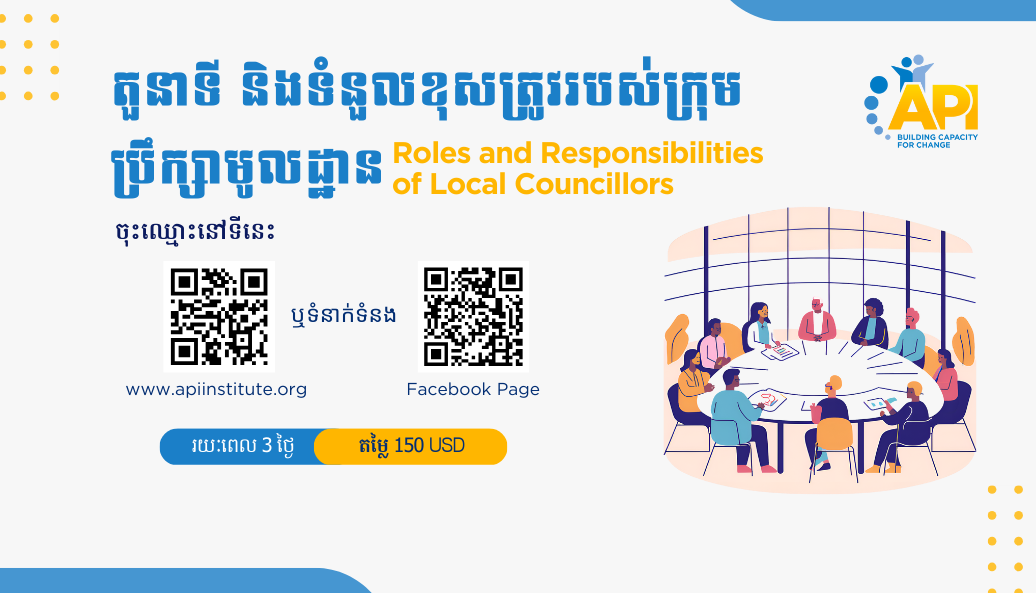
Roles and Responsibilities of Local Councillors

During this course, local councillors will reflect and try to clarify their roles and responsibilities in opening spaces for and encouraging community based organisations, youth and other citizens to engage in various activities, such as the monthly meetings of local councillors, public fora, awareness raising activities or other events. Officials will be reminded about their mission to serve citizens as the right holders who elected them, as well as about the need to respond to the citizens’ requests, including requests for public information disclosure. By the end of the course, local councillors will better understand their general mandate and permissive function. Moreover, they will learn how to better monitor the implementation of local projects, how to decide on budget plans and expenses, and how to ensure all expenses are effective, efficient, and transparent.
on-demand
3 days
150 USD
Skills for Local Councillors

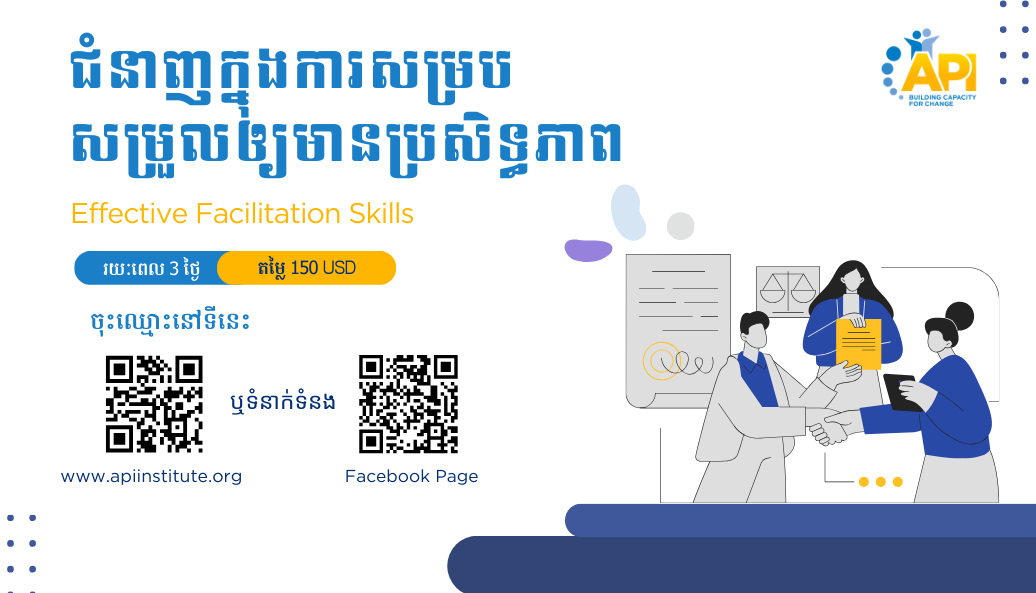
Effective Facilitation Skills

This training strengthens the participants’ capacity to facilitate council meetings and workshops. The questions we will be addressing include: What is facilitation? What is meeting, training and workshop design? What needs to be considered when organizing these events? How to effectively organize them in order to achieve the expected objectives? What are the key methods which can be used? What are the characteristics and skills a facilitator should have? How to gain those skills? What to do in a difficult circumstances, for example, when dealing with participants who lose attention or create unexpected problems? The training uses mixed methods, various exercises on meeting, training and workshop design and facilitation, as well as on requesting feedback from participants.
on-demand
3 days
150 USD