Cambodia’s public administration is undergoing rapid modernization driven by national reforms in digital transformation and decentralization. These reforms aim to enhance the quality, accessibility, and efficiency of public service delivery across the country.
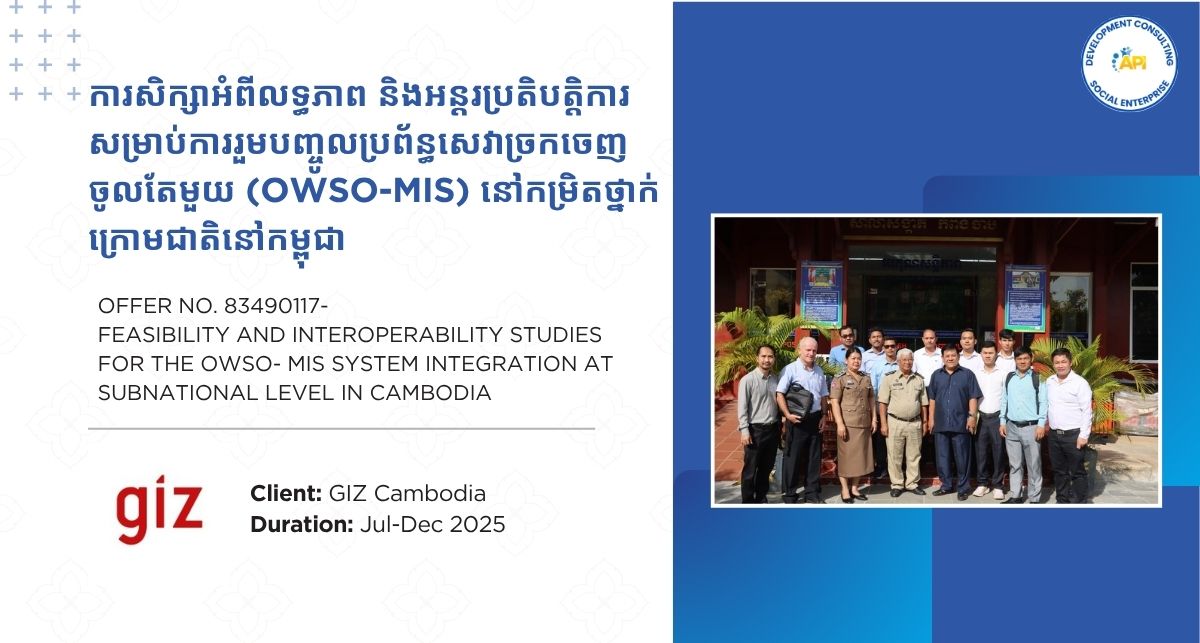
A major anchor of this digital modernization is the One Window Service Office Management Information System (OWSO‑MIS)—currently operational in more than 200 district and municipal locations. The OWSO‑MIS enables electronic processing and management of administrative services at the subnational level, creating a more transparent and responsive service environment. However, digital transformation at the Commune/Sangkat (C/S) level has progressed more slowly. Existing tools used by communes are often fragmented, manually operated, or stand‑alone, resulting in weak alignment with national systems. Critically, the absence of interoperability between the OWSO‑MIS and other government systems—such as those managed by the General Department of Identification (GDI), Ministry of Land Management, or Ministry of Public Works and Transport—limits seamless data exchange and undermines Cambodia’s broader digital governance ambitions. To address these challenges, API Development Consulting is implementing an assignment composed of two interrelated analytical studies:
1. Interoperability Assessment Between OWSO‑MIS and Government Systems
2. Feasibility Study for Integrating Commune‑Level Service Tool with OWSO‑MIS
The outcomes of both studies will inform a Digital Integration Roadmap that supports: